

Accessible Mindfulness Language: Why the Future of Mindfulness Teaching Requires More Than Good Intentions

The N.I.A. Accessible Mindfulness Language Framework™, developed by Cooke/Agnew at Mindfulness Now, was created to meet that need.
Mindfulness teaching has always been rooted in compassion, inclusion, and the desire to reduce suffering. Yet as the profession continues to mature, many teachers are asking an important question:
How accessible is the language we use?
Much attention has rightly been given to developing trauma-sensitive approaches to mindfulness. More recently, growing awareness of neurodiversity has challenged us to think more deeply about how different people experience mindfulness instructions, guided practices, and learning environments.
The result is a growing recognition that accessibility is not simply about adapting practices. It is also about adapting communication.
As mindfulness teachers, the words we choose can either support participation or create barriers to it.
The Challenge of Traditional Mindfulness Language
Many mindfulness teachers were trained using language that relies heavily on metaphor, imagery, abstraction, and open-ended exploration.
For some participants this language feels engaging and meaningful.
For others it can be confusing.
An invitation such as:
“Imagine your thoughts floating like clouds across the vast sky of awareness.”
may resonate deeply with one person.
For another participant it may feel abstract, difficult to understand, or disconnected from their lived experience.
As our understanding of neurodiversity develops, we are learning that some individuals process language differently. Many autistic people, for example, prefer communication that is direct, literal, and specific. Others may find abstract language increases cognitive effort, uncertainty, or stress.
This does not mean mindfulness needs to become rigid or clinical.
It means mindfulness teaching needs to become more accessible.
The N.I.A. Language Model™
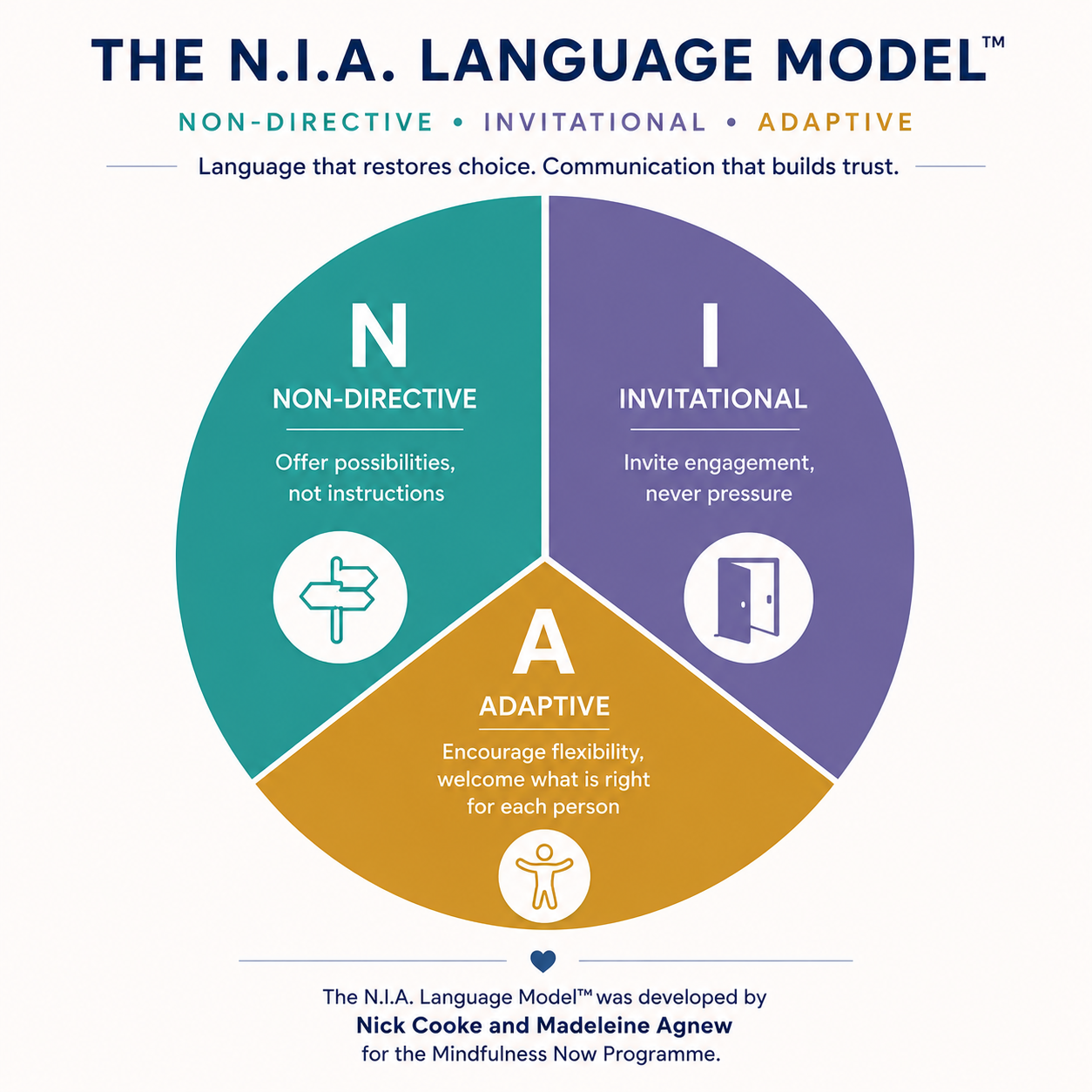
One response to this challenge has been the development of the N.I.A. Language Model™, created by Nick Cooke and Madeleine Agnew for the Mindfulness Now programme.
The model is built upon three trauma-sensitive principles:
Non-Directive
Language that avoids telling people what they should experience or how they must engage.
Invitational
Language that offers possibilities rather than instructions.
Adaptive
Language that recognises and accommodates individual differences.
Together, these principles support autonomy, choice, and psychological safety.
At a time when mindfulness teachers are increasingly aware of trauma-informed practice, the N.I.A. model provides a practical framework for communication that restores choice and reduces unnecessary pressure.
The Missing Piece: Neurodiversity-Informed Communication
Whilst trauma-sensitive language is essential, another important consideration has emerged.
Language can be non-directive and invitational, yet still be difficult to understand.
This is where neurodiversity-informed communication becomes particularly important.
The challenge is not simply offering choice.
The challenge is offering choice clearly.
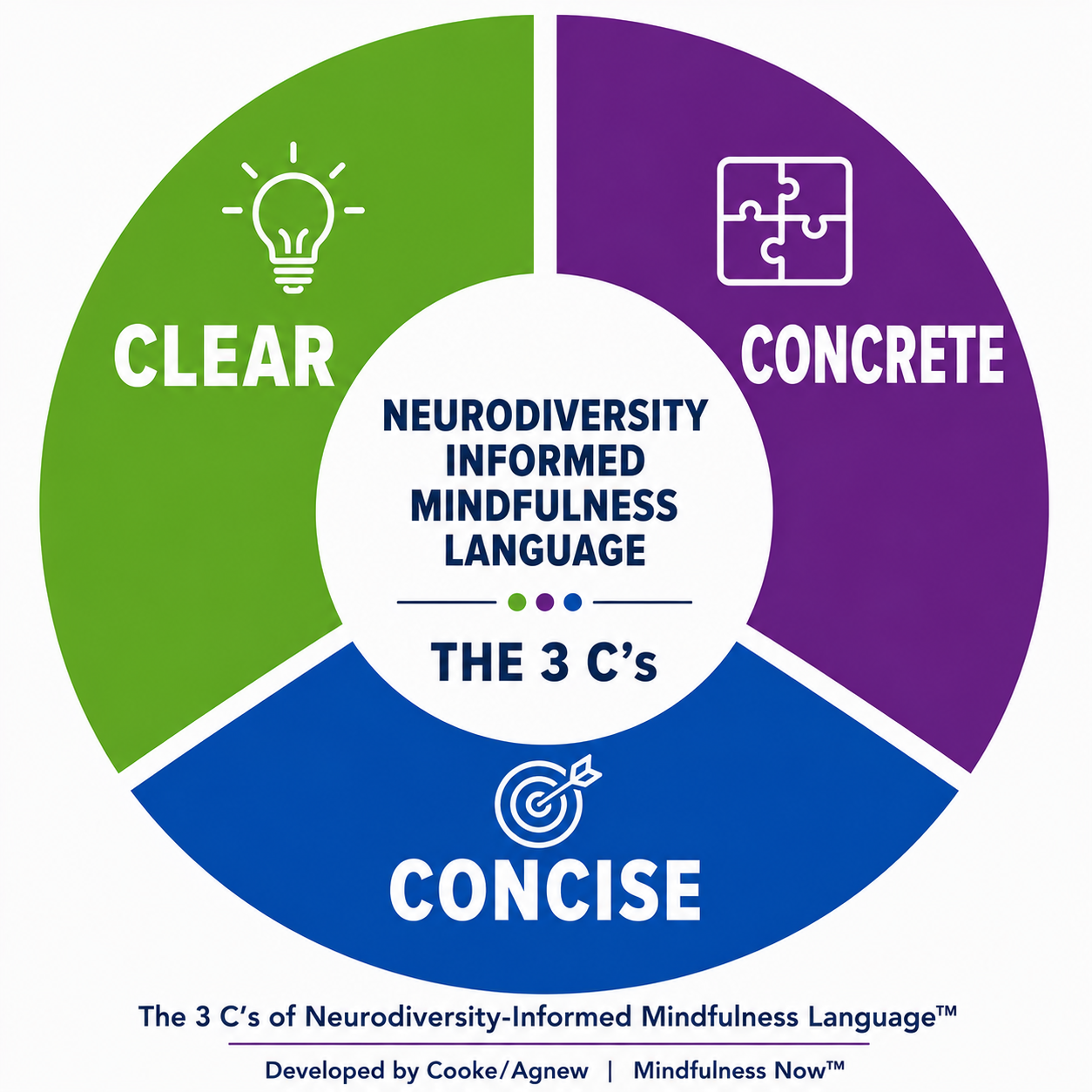
To address this, the N.I.A. Language Model is increasingly being paired with a simple communication framework known as the Three Cs of Neurodiversity-Informed Mindfulness Language.
The Three Cs
The Three Cs provide a practical guide for making mindfulness communication more accessible.
Clear
Use language that is easy to understand.
Avoid unnecessary complexity and ambiguity.
Concrete
Use language that is specific, observable, and literal.
Reduce reliance on metaphor and abstract imagery when possible.
Concise
Use only the words that are needed.
Avoid overwhelming learners with lengthy explanations or complicated instructions.
These principles benefit many learners, but they can be particularly supportive for individuals who process information differently or who prefer direct communication styles.
Bringing the Models Together
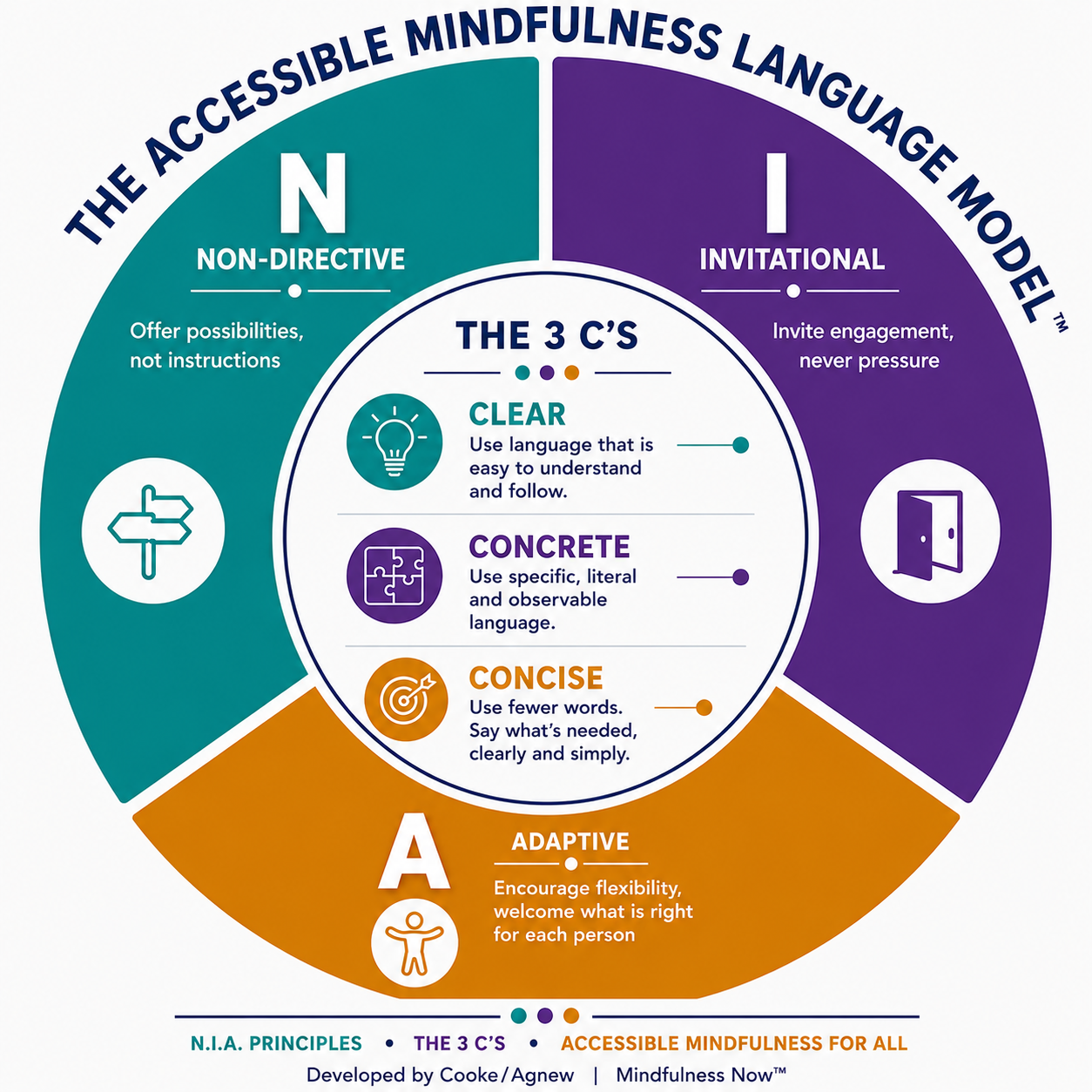
What makes this approach particularly powerful is that the N.I.A. principles and the Three Cs address different aspects of communication.
The N.I.A. model helps us think about how we offer practice.
The Three Cs help us think about how we communicate practice.
Together they create an integrated framework for accessible mindfulness teaching.
| Trauma-Sensitive Language | Neurodiversity-Informed Language |
|---|---|
| Non-Directive | Clear |
| Invitational | Concrete |
| Adaptive | Concise |
When combined, they support:
- Choice
- Clarity
- Inclusion
- Belonging
Accessibility as Professional Practice
For mindfulness teachers, accessibility is increasingly becoming a professional responsibility rather than an optional enhancement.
As teachers, we cannot assume that participants learn, process information, or engage with practice in the same way.
Nor can we assume that language that works for one person will work for everyone.
The challenge is not to abandon creativity, metaphor, or imagination altogether.
Rather, it is to develop the flexibility to communicate in ways that can be understood by a wider range of learners.
Accessible mindfulness language is not about lowering standards.
It is about removing unnecessary barriers.
The Future of Mindfulness Teaching
The future of mindfulness teaching lies not simply in what we teach, but in how we communicate it.
As the profession continues to embrace trauma-sensitive practice, neurodiversity-informed approaches, and inclusive learning environments, language will play an increasingly important role.
The combination of the N.I.A. Language Model™ and the Three Cs of Neurodiversity-Informed Mindfulness Language™ offers mindfulness teachers a practical framework for meeting this challenge.
It is a framework built on respect, flexibility, accessibility, and choice.
Most importantly, it is a framework that helps ensure mindfulness remains available to everyone.
Because accessible mindfulness begins with accessible language.
The N.I.A. Language Model™ and The Three Cs of Neurodiversity-Informed Mindfulness Language™ were developed by Nick Cooke and Madeleine Agnew through the Mindfulness Now programme as part of an ongoing commitment to accessible, trauma-sensitive and neurodiversity-informed mindfulness teaching.
Supporting Public Understanding
As mindfulness grows in popularity, members of the public may not always be aware of what constitutes safe and professional teaching.
Encouraging public literacy around trauma-informed mindfulness supports informed choice. Prospective participants may wish to ask teachers about:
- Their training in trauma-sensitive approaches
- How they respond to participant overwhelm
- Whether practices are adaptable
- Their professional supervision arrangements
Transparency builds trust and safeguards both teachers and learners.

Looking Ahead
Mindfulness has always been grounded in compassion and ethical awareness. Integrating trauma-informed principles into teaching and training reflects that same commitment in contemporary contexts.
As a professional community, continuing to strengthen safety, language and nervous system awareness supports:
- Participant wellbeing
- Teacher confidence
- Ethical clarity
- Public trust
Trauma-informed mindfulness represents not a shift away from tradition, but an evolution of professional maturity.
Welcome to the UK’s largest professional body of accredited teachers of mindfulness
The Mindfulness Teachers Association is the free professional register, and community of accredited teachers of mindfulness. It is open to all teachers of mindfulness who have a recognised, externally accredited training and qualification in mindfulness teaching. The MTA are commited to promoting, improving and upholding the highest professional standards of evidence based mindfulness practice within our community.