

Evolving Standards in Mindfulness Teaching

Trauma-Informed Mindfulness: An Ethical Imperative for Modern Teaching
As mindfulness teaching continues to expand across educational, healthcare and community settings, professional standards must evolve alongside practice.
There is growing recognition across the field that trauma-informed mindfulness is an essential component of ethical, responsible teaching. Increasing public awareness of trauma and nervous system regulation means participants are arriving in mindfulness spaces with diverse and complex lived experiences.
For professional bodies, training providers and individual teachers alike, the question is no longer whether trauma awareness is relevant — but how it is meaningfully integrated into teaching and training pathways.
Mindfulness Practice and Nervous System Awareness
Mindfulness invites individuals to turn attention inward — towards thoughts, emotions and bodily sensations. For many, this is beneficial and stabilising. For some, particularly those affected by trauma, inward attention may activate survival responses such as fight, flight, freeze or dissociation.
Research in trauma and neuroscience, including work associated with the Trauma Research Foundation and Polyvagal Theory, has deepened understanding of how the nervous system responds to perceived threat. This knowledge is increasingly informing therapeutic and educational settings.
Mindfulness teaching does not replace trauma therapy. However, mindfulness teachers benefit from understanding:
Signs of dysregulation
The impact of trauma on attention and interoception
How certain practices (e.g. breath awareness, body scans, extended silence) may affect different participants
The importance of scope of practice and referral pathways
Embedding this knowledge within teacher training strengthens both participant safety and professional confidence.
Trauma-Informed Mindfulness in Practice
Trauma-informed mindfulness prioritises:
- Psychological and physiological safety
- Participant choice and autonomy
- Gradual pacing and titration of practices
- Clear communication of options
- Respect for individual boundaries
This approach does not dilute traditional mindfulness practice. Rather, it refines delivery in light of contemporary understanding.
Importantly, trauma-informed teaching does not assume trauma in every participant. It assumes diversity of experience and creates conditions that are safe for a wide range of nervous systems.
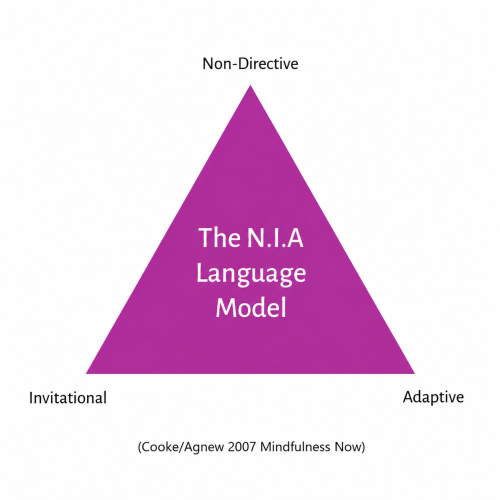
The Role of Language: NIA (Non-Directive, Invitational, Adaptive)
Language is central to trauma-informed mindfulness.
Directive instruction, even when gentle, can inadvertently reduce participant agency. Trauma-informed teaching therefore often incorporates the NIA model of language. The N.I.A Language Model was first developed by Nick Cooke and Madeleine Agnew for the Mindfulness Now Programme.
Non-Directive – avoiding commands
Invitational – offering options
Adaptive – encouraging participants to adjust practice to their needs
For example:
- “If it feels comfortable, you might allow the eyes to close — or lower the gaze.”
- “You may wish to notice the breath, or perhaps another anchor that feels steady.”
- “You are welcome to adjust your posture at any time.”
This form of language restores choice, supports autonomy and reinforces safety.
Within mindfulness teacher training, developing fluency in NIA language can be considered a core professional competency..
Integrating Trauma Awareness into Teacher Training
As mindfulness teaching becomes more widely available, teacher training programmes carry increased responsibility.
There is increasing agreement across professional communities that trauma awareness should not be an optional specialist module. Rather, it should be woven throughout training, including:
- Foundations of nervous system literacy
- Ethical scope of practice
- Responding to participant distress
- Safe adaptation of practices
- Appropriate signposting and referral
Many organisations are already incorporating these elements into training pathways. Continued collaboration and shared standards will further strengthen the field.
Supporting Public Understanding
As mindfulness grows in popularity, members of the public may not always be aware of what constitutes safe and professional teaching.
Encouraging public literacy around trauma-informed mindfulness supports informed choice. Prospective participants may wish to ask teachers about:
- Their training in trauma-sensitive approaches
- How they respond to participant overwhelm
- Whether practices are adaptable
- Their professional supervision arrangements
Transparency builds trust and safeguards both teachers and learners.

Looking Ahead
Mindfulness has always been grounded in compassion and ethical awareness. Integrating trauma-informed principles into teaching and training reflects that same commitment in contemporary contexts.
As a professional community, continuing to strengthen safety, language and nervous system awareness supports:
- Participant wellbeing
- Teacher confidence
- Ethical clarity
- Public trust
Trauma-informed mindfulness represents not a shift away from tradition, but an evolution of professional maturity.
Welcome to the UK’s largest professional body of accredited teachers of mindfulness
The Mindfulness Teachers Association is the free professional register, and community of accredited teachers of mindfulness. It is open to all teachers of mindfulness who have a recognised, externally accredited training and qualification in mindfulness teaching. The MTA are commited to promoting, improving and upholding the highest professional standards of evidence based mindfulness practice within our community.